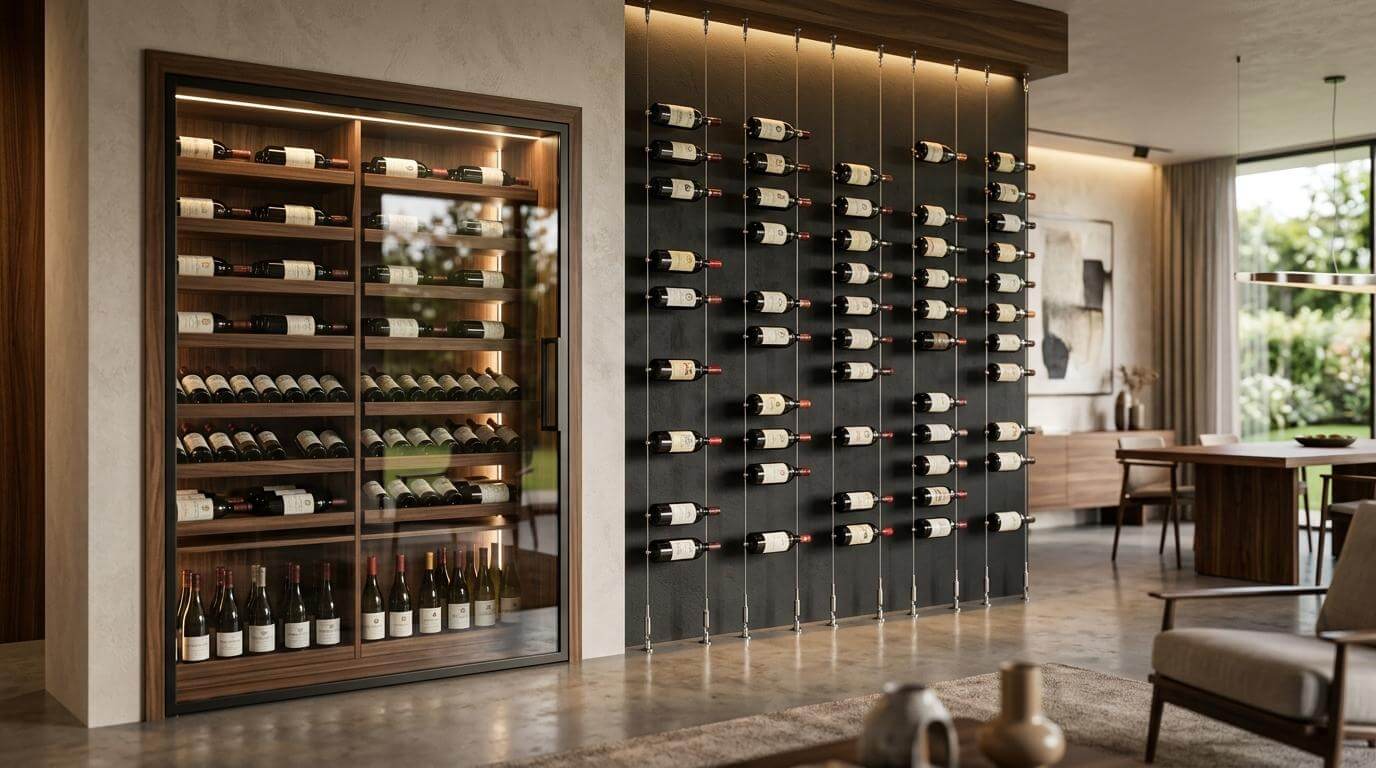
Your collection outgrew the kitchen counter months ago. Now you have bottles in a closet, a few boxes under the stairs, and a growing sense that you need a real home for it all. The wine cabinet vs wine rack question usually shows up right here, at the point where you have enough wine to want it stored well and displayed on purpose, not stacked wherever there was room.
The two answers pull in opposite directions. An enclosed cabinet hides bottles behind a door and, in cooled models, seals them inside a controlled climate. Open racking or a floating wine wall does the reverse: it puts the collection on the wall where you can see every label, with air moving freely around each bottle. This guide compares the two across the factors that actually matter- display, capacity, airflow, climate, space, and cost- and gives you a straight answer on where each one wins.
Wine Cabinet vs Wine Rack: What’s the Real Difference?
One is enclosed furniture. The other is open display racking. The choice comes down to whether you want the collection hidden and climate-sealed, or shown off and breathing.
That single distinction drives almost everything else, from how many bottles you can hold to what your monthly power bill looks like. So it helps to define each one clearly before lining them up side by side.
What Is a Wine Cabinet?
A wine cabinet is a freestanding, furniture-style piece that encloses your bottles behind a solid or glass door. Basic versions are storage furniture and nothing more. Higher-end models, sometimes sold as wine display cabinets, add a compressor for cooling and humidity control, turning the cabinet into a small, climate-managed box for your wine.
Cabinets come in warm wood, and in metal wine cabinets with a more industrial or contemporary look. The defining trait is the enclosure. A cabinet is a container first, and whatever it holds sits inside that fixed footprint.
What Is a Wine Rack or Wine Wall?
A wine rack is an open structure that holds bottles without sealing them in. A floating wine wall is the premium version of that idea: bottles suspended on high-tension stainless-steel cables, mounted to an existing wall or spanning floor to ceiling, so the collection reads as a design feature rather than a piece of furniture. You can see our own custom cable wine racking for how the floating look works in a real room.
Open racking maximizes visible display and lets air move freely around every bottle and label. It also uses almost no floor space, since it lives on the wall.
Here is the honest caveat, and it stays visible throughout this guide: a wine wall is a display and racking system, not a cooling unit. It does not generate its own climate. For long-term aging, it needs to sit in a room that already holds good conditions, or pair with a cooled space. A cooled cabinet, by contrast, brings its own climate with it.
Wine Cabinet vs Wine Rack: Pros and Cons at a Glance
Short verdict: a cooled cabinet is the simplest self-contained way to age a modest, hidden collection, and open cable racking or a wine wall is the better answer when you want to display a growing collection and your room can hold decent conditions. The table below breaks that down factor by factor.
| Factor | Wine cabinet | Wine rack/wine wall |
| Look/display | Bottles hidden behind a door; the cabinet itself is the object on show | Open, on-display feature wall; every label faces the room |
| Capacity & scalability | Fixed footprint, capped at the model you buy | Modular, floor-to-ceiling, add sections as the collection grows |
| Airflow around bottles | Enclosed, air circulation restricted inside the box | Open, air moves freely around each bottle and label |
| Climate control | Cooled models hold around 55°F (13°C) and 50 to 70% humidity on their own | Relies on the room’s conditions; pairs with a climate-controlled space for aging |
| Space & placement | Freestanding furniture that takes up floor area | Wall-mounted, uses vertical space and almost no floor |
| Cost (USD) | Cooled cabinets often run a few hundred dollars to well past $20,000 | Priced by racking material and installation; a fraction of a built-in cellar |
| Best for | Long-term aging of a smaller, hidden collection with no dedicated room | A display-forward collection in a room that already holds good conditions |
A couple of rows deserve a closer look, because they are where the two options separate most.
Airflow is the quiet one. Inside an enclosed cabinet, air is fairly still, and bottles packed together share that stagnant pocket. Open racking sidesteps the problem entirely, since nothing traps the air around your bottles. If you want to go deeper on the display and airflow advantages of open cable racking, our benefits page lays them out.
Capacity is the other. A cabinet holds what it holds. When you fill it, your options are to stop buying or to buy a second cabinet. A wine wall grows with you, one section at a time, up the wall you already have.
Which Factors Should Actually Decide It?
Match the storage to your room and your collection, not the other way around. Three questions settle most of these decisions, and they matter more than any single spec.
How Much Do You Want to Display Versus Hide Your Collection?
Decide whether the wine is meant to be seen. If your collection is part of how you want the room to feel, open racking is built for exactly that, and a cabinet works against it by hiding everything behind a door.
This is where a wine wall does something a cabinet cannot. Bottles float on the wall, labels forward, and the collection becomes a design element in the space instead of a box parked against it. Our gallery shows real installed wine walls, which is the fastest way to see whether the look fits your home. If you would rather the wine stay out of sight, a closed cabinet is the honest pick, and you can stop reading here.
How Big Is Your Collection, and Will It Grow?
Size the storage to where the collection is heading, not where it is today. A dozen bottles that will stay a dozen bottles fits neatly in a small cabinet. A collection that keeps expanding needs something that expands with it.
Modular racking is the answer to a growing collection. You add sections as you buy more wine, scaling up the same wall rather than replacing the whole setup. A wine cabinet has a ceiling built in from the day you buy it, and outgrowing it means starting over.
Does Your Space Already Hold Good Conditions?
Check the room before you choose. Wine keeps best at around 55°F (13°C), with 50 to 70% relative humidity and roughly 60% as the ideal. Consistency matters more than hitting an exact number, so a steady room beats one that swings warm and cold.
If your space already sits near those conditions, open racking or a wine wall is a strong fit, since the room does the climate work and the racking does the display. If it does not, be honest with yourself about it. A cooled cabinet brings its own climate, and a wine wall installed in a climate-controlled room or dedicated wine room gets you the display plus the conditions. What does not work is expecting open racking alone to substitute for a room that runs hot or dry.
A Mistake Worth Avoiding
The common misstep is buying a cooled cabinet you will outgrow when a modular wine wall in an already-conditioned space would have scaled much further for the money. It is easy to solve today’s storage and forget that the collection keeps growing.
The reverse mistake matters too. Do not expect open racking on its own to hold wine at temperature in a room that runs warm. The racking displays and stores. The room, or a dedicated cooling system around it, controls the climate. Get both right and the two work together. A wine cabinet and rack setup can even coexist, with a cabinet for a few bottles you want cooled now and a wine wall for the collection you want on show.
Frequently Asked Questions
Is a wine cabinet better than a wine rack?
Neither is better outright; they solve different problems. A cooled cabinet is better when you want self-contained climate control for a smaller, hidden collection and have no dedicated room. Open racking or a wine wall is better when you want to display a growing collection and your space already holds reasonable conditions.
Do wine racks or wine walls keep wine at the right temperature?
No, and this is the honest limit worth repeating. A wine rack or wine wall stores and displays your bottles; it does not control temperature or humidity. The room around it does, or a dedicated cooling system does. For long-term aging, install the racking in a climate-controlled space rather than relying on the racking alone.
How many bottles can a wine wall or cabinet hold?
A cabinet holds a fixed number set by its model, often somewhere from a few dozen to a couple hundred bottles. A wine wall is modular, so capacity depends on how much wall you use. You add sections up and across the wall as the collection grows, which is why racking scales past what a single cabinet can reach.
Are metal wine cabinets or wood racking better for display?
It depends on the look you want. Metal wine cabinets read industrial and contemporary but still hide bottles behind a door. Open cable racking, in warm wood tones, matte black, or chrome finishes, keeps every label facing the room, so it displays more of the collection than any enclosed cabinet can, metal or wood.
What temperature and humidity should wine be stored at?
Store wine at around 55°F (13°C), with a comfortable range of 55 to 59°F. Keep relative humidity between 50 and 70%, with about 60% as the ideal. Too dry and the cork dries out; too damp and you risk mold and ruined labels. Steady conditions matter more than a perfect number.
Conclusion: Making the Right Call for Your Space
The decision really is this simple. A cabinet hides and seals your wine, which suits a smaller collection with no dedicated room. Open cable racking and wine walls display and breathe, which suits a growing collection in a space that already holds good conditions. One keeps the wine out of sight, the other makes it part of the room.
If you lean toward display, want your collection to scale, and have a space you can keep near 55°F (13°C) and 50 to 70% humidity, a custom wine wall is likely your best fit. Ready to see what one could look like in your home? Request a quote from Cable Wine Systems and get a custom design built around your room and your collection.