
Wine bottle size varies far more than most people expect, and that variation is exactly what makes or breaks a wine rack design. A standard 750ml bottle is only the starting point, and a real collection quickly adds Champagne, Burgundy, magnums, and half bottles, each with its own height and diameter. If the racking does not account for them, bottles end up crammed in awkwardly or left off the wall.
At Cable Wine Systems, we build modern wine walls that suspend bottles on high-tension cables, and racking that fits the collection is one of the details that separates a display that works from one that just looks good. This guide covers standard wine bottle dimensions, common formats and how they differ, and how those sizes shape the design of your wine wall.
What Is the Standard Wine Bottle Size?
The standard wine bottle holds 750ml and stands roughly 12 to 13 inches tall (300 to 330 mm) with a diameter of around 3 inches (75 mm).
That 750ml format covers the large majority of wine sold, which is why racking is designed around it as the default. The exact height and width vary slightly across producers and bottle shapes, so a well-designed wall allows a little clearance for taller bottles. The variation matters most once you move beyond the standard bottle.
Common Wine Bottle Sizes and Dimensions
Beyond the standard bottle, wine comes in a range of formats, and each one has a different footprint on the wall. The figures below are typical approximate dimensions, since they vary by producer.
| Format | Volume | Typical height | Typical diameter |
| Split (Piccolo) | 187.5ml | 7.5 to 8 in (190-200 mm) | 2 in (50 mm) |
| Half (Demi) | 375ml | 9.5 to 10.5 in (240-265 mm) | 2.4 in (60 mm) |
| Standard | 750ml | 12 to 13 in (300-330 mm) | 3 in (75 mm) |
| Magnum | 1.5L | 15 to 16 in (380-400 mm) | 4 to 4.7 in (100-120 mm) |
| Double Magnum | 3L | 17 to 20 in (430-500 mm) | 5 in (130 mm) |
| Jeroboam | 3L to 5L | 20 to 22 in (500-560 mm) | 5 to 6 in (130-150 mm) |
A standard case holds twelve 750ml bottles, which is the other unit collections are planned around. The large formats are where off-the-shelf racking falls short, because a magnum will not fit a space sized for a standard bottle.
Why Bottle Shape Varies
Even at the same 750ml volume, bottles are not the same shape, and shape changes how they sit on the wall.
-
Bordeaux. Straight sides and high shoulders, the narrowest common bottle at around 3 inches (75 mm), and the easiest to rack densely.
-
Burgundy. Wider with sloping shoulders, often 3.2 to 3.5 inches (80 to 90 mm) across, so it needs more room between rows.
-
Champagne. Heavier, thicker glass with a deep punt, wider at roughly 3.5 inches (90 mm) and often taller, and it needs the sturdiest support.
This is why a wall built only for Bordeaux bottles struggles with a Burgundy-heavy or Champagne-heavy collection. The spacing has to suit the widest bottles you actually own.
Large-Format Bottles and Why Collectors Buy Them
Above the magnum, large-format bottles carry traditional names, and collectors prize them for both special occasions and aging.
| Name | Volume | Standard bottles |
| Magnum | 1.5L | 2 |
| Double Magnum | 3L | 4 |
| Jeroboam | 3L or 4.5L | 4 to 6 |
| Rehoboam | 4.5L | 6 |
| Methuselah / Imperial | 6L | 8 |
| Salmanazar | 9L | 12 (a full case) |
| Balthazar | 12L | 16 |
| Nebuchadnezzar | 15L | 20 |
The Jeroboam is the one to watch, because it holds 3 liters in Champagne and Burgundy but 4.5 liters in Bordeaux.
Beyond the numbers, large formats matter for a display because they age more slowly. There is less air relative to wine inside a big bottle, which is one reason serious collectors keep them. They also need their own dedicated rows, so they belong in the wall plan from the very start.
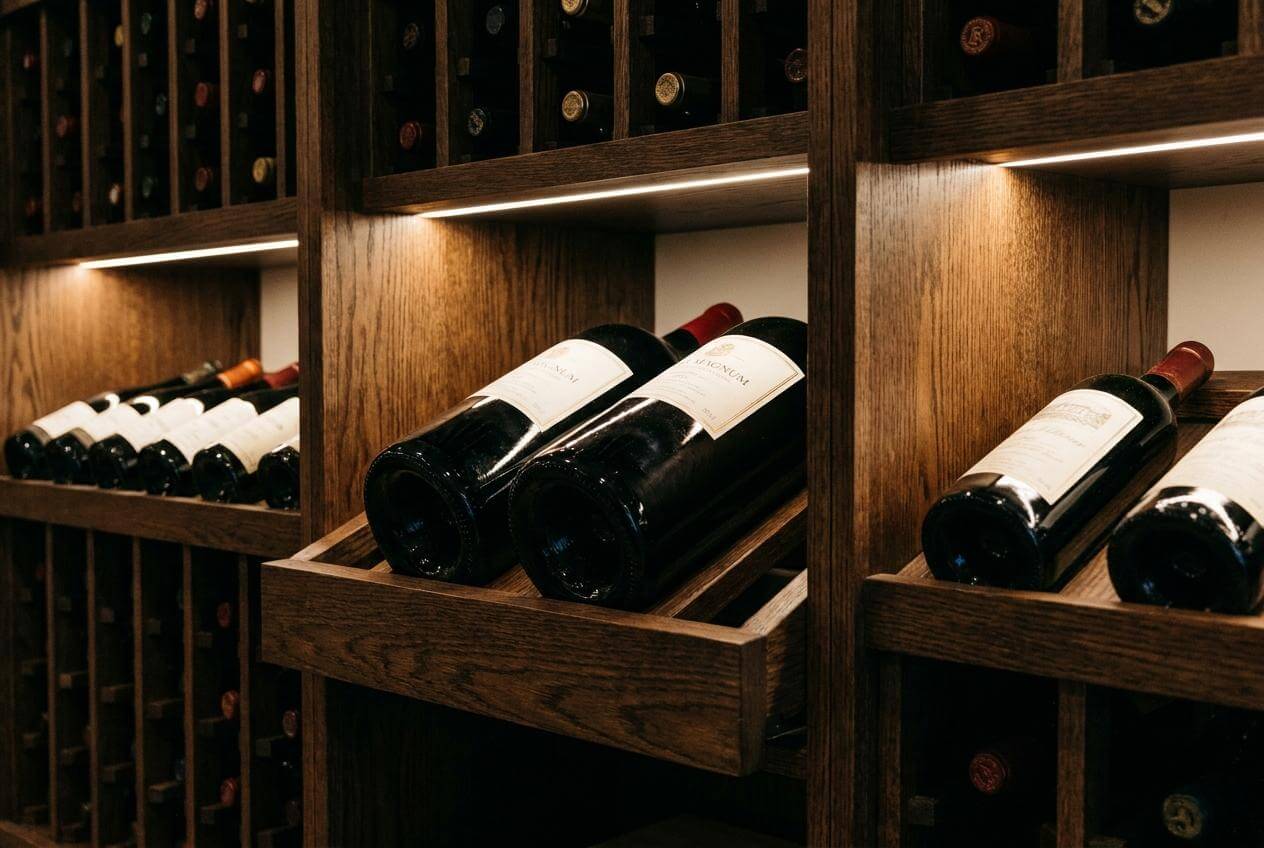
How Bottle Sizes Affect Your Wine Rack Design
Bottle dimensions drive three racking decisions: the spacing between rows, the support each bottle needs, and where the large formats go.
-
Row spacing. Standard spacing suits a 750ml bottle. Wider bottles need more room between rows so labels stay visible and bottles sit level.
-
Support and projection. Bigger, heavier bottles need sturdier support and sit farther off the wall, which the design has to allow for.
-
Dedicated large-format rows. Magnums and larger belong in their own rows, which are planned in from the start rather than squeezed in later.
Getting this right is the difference between a wall that holds its full stated capacity and one that wastes space. A cable wine wall is built to order, so the spacing and supports are matched to the bottles you actually own, and it scales section by section as the collection grows.
Planning a Wine Wall for a Mixed Collection
Most serious collections are mixed, so the display has to be too. A good design plans for the full spread of formats a collection includes.
-
Bulk rows for the standard 750ml bottles that make up most of the collection.
-
A large-format section with wider, sturdier rows for magnums and up.
-
A display row for bottles worth showing label-out, which also suits odd shapes.
-
Room to grow, because a collection that fits perfectly today will not in two years.
Planning for the formats you collect, and the ones you are likely to add, keeps the wall tidy and makes the most of the space you have. A modern wine rack that scales section by section makes that easy.
Common Wine Rack Mistakes (and the Fix)
Mistake 1: Sizing racking for standard bottles only
A wall built entirely for 750ml Bordeaux bottles cannot take the magnums and Champagne a real collection includes.
The fix: design the spacing and rows around the widest and tallest bottles you actually own.
Mistake 2: Buying a fixed off-the-shelf rack for a custom space
Standard racking rarely matches a wall’s exact dimensions or a mixed collection, and it wastes space.
The fix: a built-to-order wine wall designed to the wall and the collection, so no space is left stranded.
Frequently Asked Questions
How tall is a standard wine bottle?
A standard 750ml wine bottle is roughly 12 to 13 inches tall (300 to 330 mm). The exact height varies by producer and bottle shape, so quality racking allows a little clearance for the taller bottles.
How wide is a wine bottle?
A standard bottle is around 3 inches (75 mm) in diameter. Burgundy and Champagne bottles are wider, often 3.2 to 3.5 inches (80 to 90 mm), which is why row spacing is matched to the widest bottles in a collection.
How big is a magnum wine bottle?
A magnum holds 1.5 liters, the equivalent of two standard bottles, and typically stands 15 to 16 inches tall (380 to 400 mm) with a diameter of 4 to 4.7 inches (100 to 120 mm). Its size is why magnums need dedicated rows.
Does bottle size affect how you store wine?
Yes. Bottle height, width, and shape all determine the row spacing, support, and dedicated rows a display needs. Racking that ignores the range of sizes in a collection wastes space and leaves bottles poorly supported.
What is the smallest wine bottle size?
The smallest common format is the split, or piccolo, at 187.5ml, a quarter of a standard bottle and about 7.5 to 8 inches tall (190 to 200 mm). Half bottles at 375ml are the next size up. Both are easy to lose on a standard wall, so they are best given their own row.
How much space does a case of wine take up?
A standard case holds twelve 750ml bottles. On a wine wall, planning bulk rows for these standard bottles keeps the everyday wine compact and frees up the feature rows for the bottles worth showing off.
Conclusion: Design Your Display Around Your Collection
Bottle sizes are the quiet detail that decides whether a display holds its full capacity or wastes it, so it is worth planning the wall around the wines you actually collect.
Ready to see what a wine wall could look like in your space? Request a quote from Cable Wine Systems and get a custom design built around your room and your collection.